
The Phenomenon of Fantasy Notes in Art and Notaphily
The Illusion of Sovereignty and the Value of an Imagined "Piece of Paper"
Have you ever stopped to think about what you actually carry in your wallet besides payment cards? Banknotes. Money. From a purely physical standpoint, it is merely a blend of cotton, paper, and ink, which in itself holds no real value except for the one we, as a society, have collectively agreed upon [1]. Money is essentially humanity's most successful fictional medium of exchange. But what happens when this strictly guarded social contract is disrupted by artists? Fictional banknotes, known in international terminology as fantasy notes, represent a unique phenomenon where the austere world of mathematics and finance collides with human imagination and the desire for beauty.
Money as a Social Contract and Fantasy Notes as the Perfect Illusion
The relationship between money and art has historically been defined primarily through patronage—where the wealthy class purchased art as a display of their status—or through market commodification. However, in the second half of the 20th century and at the beginning of the 21st century, a parallel, highly subversive phenomenon established itself: the creation of fictional banknotes, also known as fantasy notes [2, 3]. As objects, fantasy notes formally and aesthetically mimic the structural attributes of state currencies perfectly—utilizing guilloches, portraits, serial numbers, and specific color palettes, often printed on watermarked paper. The fundamental difference, however, lies in the fact that for the most part they are not bound to real market circulation and are marked as "Not legal tender" or, for example, "Art only – Non negotiable" and the like [2, 3]. While in philately there is a long-recognized, yet rather decorative equivalent in the form of fictional stamps (cinderella stamps), in notaphily, fictional banknotes represent a much more complex phenomenon. They transcend the boundaries of pure collecting and directly intervene in the realms of conceptual art, performance, and institutional critique [3, 4, 5, 6]. They are a perfect artistic tool that exposes the illusion of money. Fantasy notes point out that the real value of money is derived solely from our collective faith in the institution that emits it [6, 1].
Stories of Courage and Resistance: From Courtrooms to Street Performances
Source: Author's archive
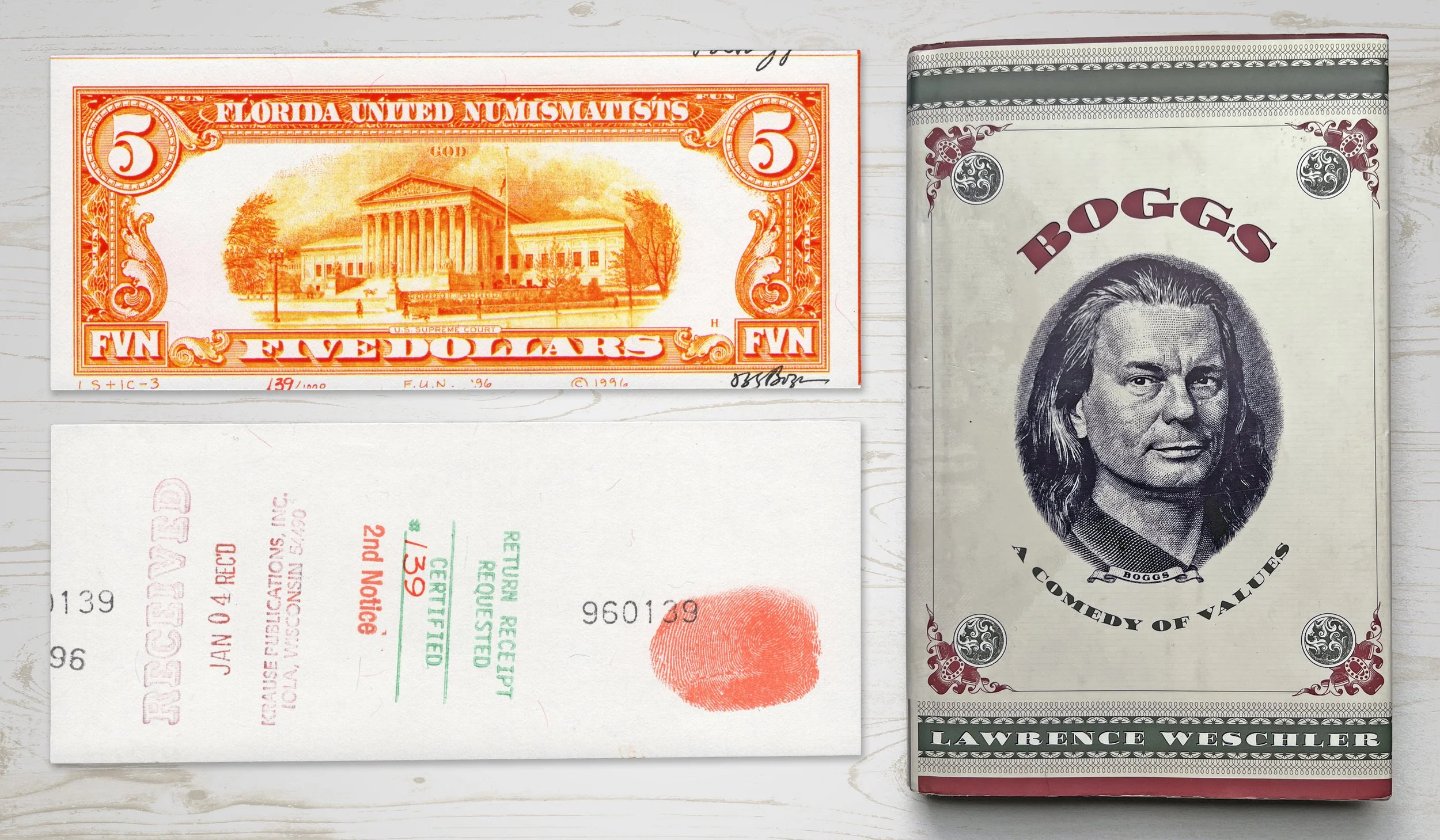
The creation of fictional currency is not merely a harmless aesthetic exercise. In many cases, it was or is a direct act of rebellion and personal courage that often brought artists into direct conflict with state power. Attempting to pay with hand-drawn money because one cannot afford groceries requires not only a certain wit, but also a good deal of courage and willingness to take risks. A pioneer in this field was the American artist J. S. G. Boggs. In the 1960s (note: historically active from 1984), he not only meticulously hand-drew banknotes, but he also attempted to spend them in real life. Boggs's "performance" consisted of offering his drawing for food or services at the exact face value of the item, and demanding change from the merchant in real, legal tender currency. This conceptual artistic approach, which literally helped Boggs survive during a certain period, brought him not only fame but also arrests and long-term legal battles with secret services and the Bank of England [12, 14, 15, 16]. Equally fascinating is the case of the Japanese avant-garde artist Genpei Akasegawa from the 1960s. He conceived one of his works by printing one-sided copies of a 1000-yen banknote. Despite this, the state accused him of counterfeiting, which culminated in a legendary trial during which Akasegawa and his defense team transformed the courtroom itself into an art gallery, and prominent Japanese art historians and critics defended his work [17, 18]. However, the court did not accept the arguments and handed down a three-month suspended sentence to the artist [18]. Akasegawa responded to the verdict by creating the work Greater Japan Zero-yen Note (1967) [10].
From Childhood Fascination to a Lifelong Concept: Matej Gábriš and His Brand
While artists like Boggs or Akasegawa used banknotes primarily as a tool for one-off institutional critique or performance, there is another, more systematic approach to this medium. In a local, yet today globally respected context, it is represented by the Slovak creator Matej Gábris and his brand GABRISNOTE® [20, 22, 23]. For Matej, fantasy notes were not just a form of protest or social critique. Already in his childhood, he discovered that drawing and creating his own monetary systems was his lifelong passion. While other children abandoned their fictional worlds as they grew up, Matej subordinated his entire professional life to this specific field. He studied printing technologies, penetrated the secrets of professional "security design" and protective element technology, ensuring that his visions were not merely naive drawings, but professional security documents. This uncompromising approach shaped him into an internationally recognized master whose works hold a firm position in the portfolios of global collectors.
The Market Paradox and Collecting Passion
When studying the phenomenon of fantasy banknotes, however, we encounter an exceptionally fascinating paradox. It is an irony (though not entirely uncommon in art) that these originally anti-systemic artworks that question the very essence of money eventually become commercial blockbusters [7, 19]. The most brilliant example of this paradox is the iconic ten-pound note by the anonymous British street artist performing under the pseudonym Banksy.
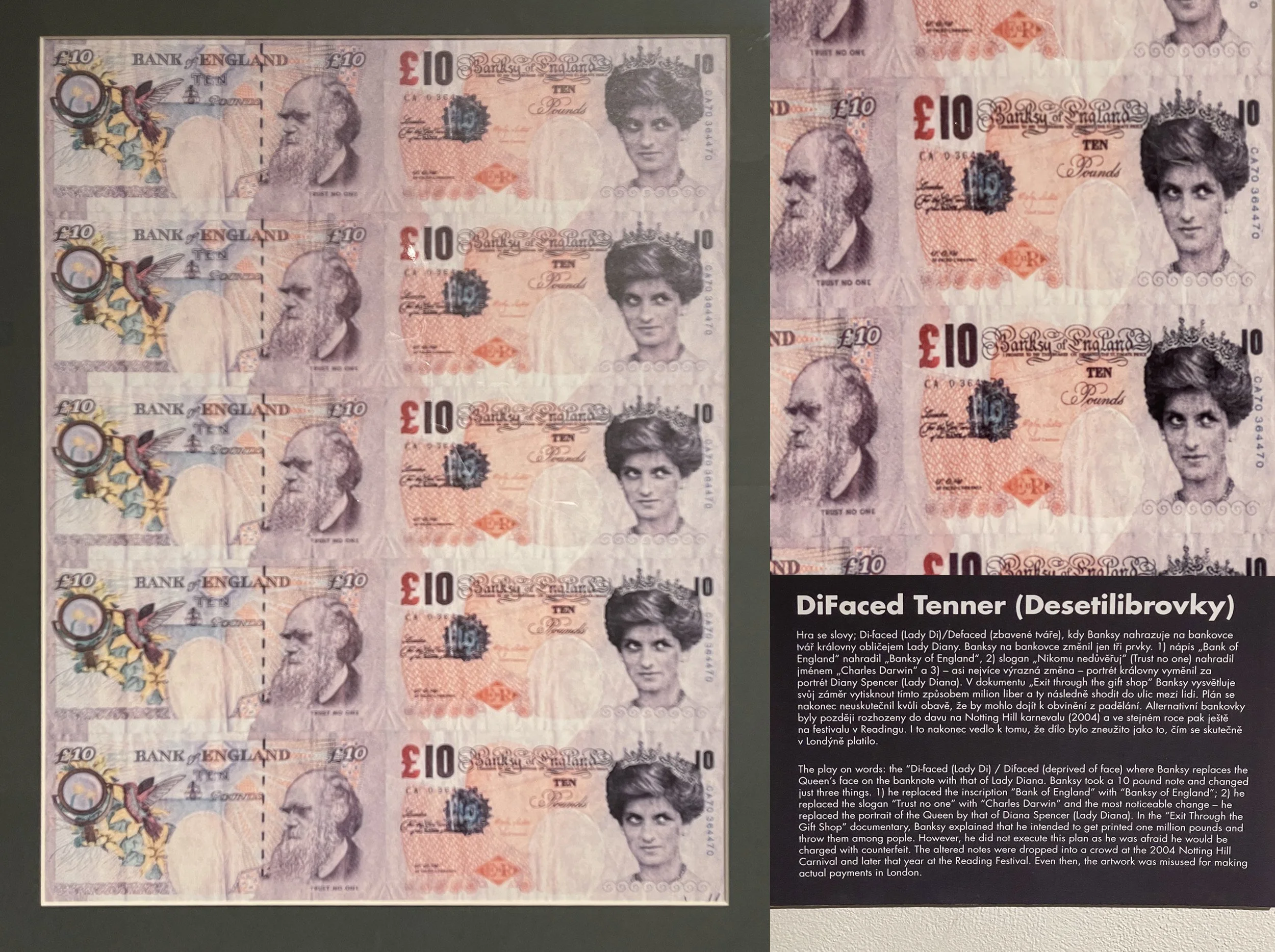
Photos from a visit to the Banksy exhibition in Prague. Source: ArtBook Garden AS Archives.
Banksy and Di-Faced Tenners
The fantasy notes named "Di-Faced Tenners" were created in August 2004. Legend has it that these banknotes were created in collaboration between Banksy and his fellow street art scene colleague named D*Face. In this case, however, the name "Di Faced" is actually a play on words derived from the word "defaced" and refers to the fact that Banksy altered the well-known 10-pound banknote by replacing the portrait of Queen Elizabeth II with the likeness of the late Princess Diana. This work can be seen as a commentary on Diana's estrangement from the royal family, her critique of the British royal institution, and her subsequent hounding by the press. Instead of "Bank of England", the banknote reads "Banksy of England". Below the inscription, it states: "I promise to pay the bearer the ultimate price upon request," a reference to the late princess's fate at the hands of the media. The back of the print remains essentially unchanged, except for the motto "Trust No One" written in the lower right corner under the portrait of Charles Darwin. The banknote is printed with ink on paper almost identical to that used for official currency issued in Great Britain. In August 2004, Banksy printed at least 100,000 "Di Faced Tenners"—a total of £1,000,000 in counterfeit currency. Banksy created them for a public art event where he dropped a suitcase full of fake banknotes into a crowd at the Notting Hill Carnival and the Reading Festival. Some of these counterfeit notes were used by festival-goers as actual currency. Unlike the American artist J. S. G. Boggs, who is known for his hand-drawn depictions of banknotes, Banksy was never prosecuted for counterfeiting. The suitcase containing the "Di Faced Tenners" was also exhibited at the Santa's Ghetto exhibition, which took place in December 2004 on Charing Cross Road [19]. With the success of the project, a massive number of counterfeits appeared on the internet, which prompted Banksy's authentication organization, Pest Control, to introduce an unprecedented method of verification. Original Di-Faced Tenners are authenticated by Pest Control staff (Pest Control is the sole certification authority that can verify and recognize his work as genuine) physically tearing the banknote in half. They keep one half in their archive and staple the other half to the official certificate of authenticity [19]. This destructive process paradoxally confirms the integrity of the work and increases its value on the secondary market. The definitive final touch to the legitimization of this street artwork came from the British Museum, which in February 2019 acquired a Di-Faced Tenner for its permanent collection of coins and paper money, institutionally placing it on the same level as official historical currencies [19]. Today's market success of fantasy notes reveals the paradox of the commodification of subversive art [7]. Projects that originated as a mockery of the capitalist fetish of money have themselves become highly valued commodities today, purchased by investors as alternative assets with demonstrable annual growth [7, 19]. This fact highlights the deepest point of not only money art: art can transform any value (including fictional "pieces of paper," a banana taped to a wall by Maurizio Cattelan, or an old toilet bowl exhibited by M. Duchamp) into real wealth. And collecting passion possesses the exact same power and meaning. But more on that another time in a future post.
Bibliography
[1] Genpei Akasegawa's 1000 Yen Note Incident. [Online]. In: Photography and the Archive Research Centre. 2019. Available from: https://wmuphoto.wordpress.com/2019/10/16/genpei-akasegawas-1000-yen-note-incident/. [accessed 2026-06-11].
[2] Changes in the catalogue categories [opgelost]. [Online]. In: Numista Forum. Available from: https://nl.numista.com/forum/topic144308.html. [accessed 2026-06-11].
[3] Changes for fantasy coins and banknotes. [Online]. In: Numista Forum. Available from: https://it.numista.com/forum/topic151560.html. [accessed 2026-06-11].
[4] Banknote World's Guide on Collectible Banknotes: Bank Issued vs Novelty / Fantasy. [Online]. In: Banknote World Blog. Available from: https://www.banknoteworld.com/blog/banknote-worlds-guide-on-collectible-vs-novelty-fantasy-banknotes/. [accessed 2026-06-11].
[5] J. S. G. Boggs. [Online]. In: Wikipedia: The Free Encyclopedia. Available from: https://en.wikipedia.org/wiki/J._S._G._Boggs. [accessed 2026-06-11].
[6] HAIVEN, Max, 2015. Money as a Medium of the Imagination: Art and the Currencies of Cooperation. [Online]. In: MoneyLab Reader: An Intervention in the Digital Economy (Institute for Network Cultures). P. 1-16. Available from: https://www.academia.edu/9646711/Money_as_a_Medium_of_the_Imagination_Art_and_the_Currencies_of_Cooperation. [accessed 2026-06-11].
[7] Zero dollar, 1974 - 1984 | Cildo Meireles. [Online]. In: MACBA Museum of Contemporary Art of Barcelona. Available from: https://www.macba.cat/en/obra/r3806-zero-dollar/. [accessed 2026-06-11].
[8] Art, Money, and the Gift: J.S.G. Boggs' (Im)possible Currency. [Online]. In: Érudit. 2010. Available from: https://www.erudit.org/en/journals/rssi/2010-v30-n1-2-3-rssi01475/1025928ar.pdf. [accessed 2026-06-11].
[9] Zero Dollar – Works. [Online]. In: Blanton Museum of Art. Available from: https://blanton.emuseum.com/objects/16512/zero-dollar. [accessed 2026-06-11].
[10] AKASEGAWA, Genpei. Model 1000-Yen Notes lll. [Online]. In: J Art Foundation. Available from: https://jartfoundation.com/en/collection/model-1000-yen-notes-lll/. [accessed 2026-06-11].
[11] Money in Art. [Online]. In: Agenda Bookshop. Available from: https://agendabookshop.com/products/money-in-art-from-coinage-to-crypto. [accessed 2026-06-11].
[12] WESCHLER, Lawrence. Lawrence Weschler and J. S. G. Boggs. [Online]. In: New York Writers Institute. Available from: https://www.albany.edu/writers-inst/webpages4/archives/weschler.html. [accessed 2026-06-11].
[13] Defaced! Money, Conflict, Protest Large print. [Online]. In: AWS. Available from: https://fitz-cms-images.s3.eu-west-2.amazonaws.com/defaced-money-conflict-protest.-large-print-labels..pdf. [accessed 2026-06-11].
[14] RIP JSG Boggs (1954/55–2017). Online. In: The Chicago Blog. 2017. Available from: https://pressblog.uchicago.edu/2017/01/26/rip-jsg-boggs-195455-2017.html. [Accessed 2026-06-11].
[15] MORE ON MONEY ARTIST J.S.G. BOGGS. Online. In: Numismatic Bibliomania Society (The E-Sylum). 2017. Available from: https://www.coinbooks.org/v20/esylum_v20n06a16.html. [Accessed 2026-06-11].
[16] WESCHLER, Lawrence. Boggs: A Comedy of Values. Online. In: Google Books. Available from: https://books.google.com/books/about/Boggs.html?id=3TFYOUCBGsUC. [Accessed 2026-06-11].
[17] Impounded Objects/ Wrapped Work by Model 1000yen Notes (bag). Online. In: 100 Must-see Artworks: Japanese Contemporary Art Edition. Available from: https://art100-ncar.artmuseums.go.jp/en/100works/20-genpei-akasegawa/. [Accessed 2026-06-11].
[18] AKASEGAWA, Genpei. Dictionary of Artists in Japan (DAJ). Online. In: Art Platform Japan. Available from: https://artplatform.go.jp/artists/A1013. [Accessed 2026-06-11].
[19] Di Faced Tenners by Banksy Meaning, Analysis & Auction Results. [Online]. In: MyArtBroker. Available from: https://www.myartbroker.com/artist-banksy/series-di-faced-tenners. [Accessed 2026-06-11].
[20] Adhésion 2025 (Gábrišoviek, Matej Gábriš) - Slovakia. [Online]. In: Numista. Available from: https://en.numista.com/458232. [Accessed 2026-06-11].
[21] North American Federation Fantasy Banknotes: Collect the Unusual. [Online]. In: NumisCollection. Available from: https://www.numiscollection.com/cat-world-banknotes/fantasy-banknotes/north-american-federation/. [Accessed 2026-06-11].
[22] Notafília: Bankovky, Gábrišovky and albums. [Online]. In: eHOBBY.sk. Available from: https://www.ehobby.sk/notafilia-bankovky. [Accessed 2026-06-11].
[23] Gabris Banknote World. [Online]. In: Banknote24.eu. Available from: https://www.banknote24.eu/contents/en-us/d7375_Gabris-Banknote-World.html. [Accessed 2026-06-11].